

A man in a suit is walking off a ledge in central London and nobody has stopped him. He can't see the drop coming. He's got a flag in his hands, snapped back by the wind, wrapped across his own face. He's still marching forward like there's ground under his next step. There isn't.
What went up overnight
The statue appeared in Waterloo Place, near St James's, sometime before dawn on April 29, 2026. No announcement, no unveiling, just a life-sized fiberglass figure standing on a plinth that hadn't held anything the night before. A signature turned up on the base. By the next afternoon, Banksy's Instagram had posted an installation video set to Elgar's Pomp and Circumstance March No. 1, the same tune played at King Edward VII's coronation, closing on a passerby telling the camera how much he hates the thing. NPR and the BBC both confirmed it as his work within the day.
The neighbors he chose
Banksy didn't pick an empty corner. Waterloo Place already holds an equestrian statue of King Edward VII, cast in bronze in 1921 by the sculptor Bertram Mackennal after a commission delayed nine years by the First World War. The king sits high in Field Marshal's uniform, horse mid-stride, the picture of an empire that still believed in its own forward motion.

Two more old soldiers
A few yards off stands the Guards' Crimean War Memorial, unveiled in 1861 and cast partly from cannons captured at the siege of Sevastopol. It names 2,152 officers and enlisted men of the Brigade of Guards killed in the Crimean War, and it was moved thirty feet in 1914 to make room for the Florence Nightingale and Sidney Herbert statues that now flank it. Every monument on this stretch of pavement is a version of the same story: march forward, serve the flag, be remembered for it.

Banksy's man is doing the same march. He's just doing it blind, and there's no medal waiting where he's headed.
Reading the flag
CNN read the piece as a satire of blind patriotism, the flag doing exactly what flags are accused of doing: replacing sight with slogan. Not everyone bought the execution. Critic Alex Dale, writing for spiked, called the statue's look "the aesthetics of mass-produced garden-centre ornaments" and its message "the moral complexity of a Catchphrase clue," arguing Banksy had turned contempt for working-class patriotism into something that reads as sophistication to the people already inclined to feel it. The London art dealer Philip Mould took the opposite tack, telling reporters the piece's proportions were "perfectly right for the space," built to stand shoulder to shoulder with the bronze figures around it instead of mocking them from a distance.
The council's bet
Westminster City Council called it "a striking addition to the city's vibrant public art scene" and put up temporary fencing within weeks, protecting the statue from souvenir hunters while leaving it visible to anyone walking past. A spokesperson for Mayor Sadiq Khan added that Banksy's work "always draws great interest and debate" and said the mayor hoped this one could be preserved where it stands. That is not nothing. Banksy pieces have a habit of getting chiseled off walls, crated up, and auctioned within days of appearing. A city government asking to keep one in place, fence and all, is a bet that the joke is worth the argument it starts.

Banksy barely does statues
This is only his second real venture into sculpture. The first was The Drinker in 2004, Rodin's Thinker recast with a traffic cone jammed on its head and dropped onto a square near Shaftesbury Avenue. It got stolen within weeks by a self-described "art terrorist" and has bounced between private hands and knockoff versions ever since. The flag man arrived less than two months after a Reuters investigation tried to pin down who Banksy actually is, a story he neither confirmed nor denied. Two months later, as NPR reported again on July 1, the statue is still standing, still fenced, and still being read as a warning about what people stop seeing once they've picked a side to march for.
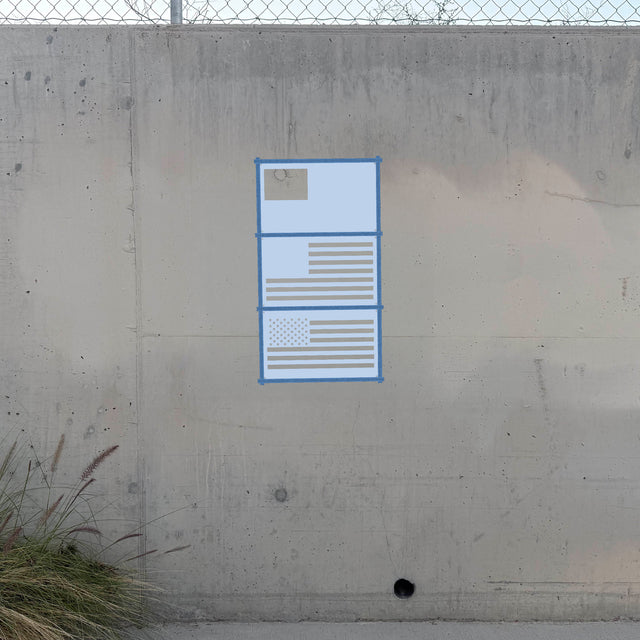
Banksy works in spray paint and cut mylar because a stencil can go up in ninety seconds and outlive the argument about whether it should exist. A statue can't move that fast, but the logic is identical: block out everything except the shape that matters, and let the wall or the plinth do the rest of the talking. That's the whole craft behind every stencil in our shop too, just built to survive a spray can instead of a foundry.
0 comments