

A sign that once burned eight miles of neon over downtown Las Vegas has been sitting dark in a boneyard for years. This December, Las Vegas turns it back on.
A Texas gambler's downtown gamble
Benny Binion built his first gambling empire in Dallas, Texas, running illegal craps and card operations across the city through the 1930s under the protection of a friendly local sheriff, according to Wikipedia. When Dallas voters threw out that sheriff in 1946, Binion loaded a Cadillac with two armed bodyguards and roughly a million dollars in the trunk and drove west that same December. He landed in Las Vegas, where the same games he had run underground in Texas were simply legal.
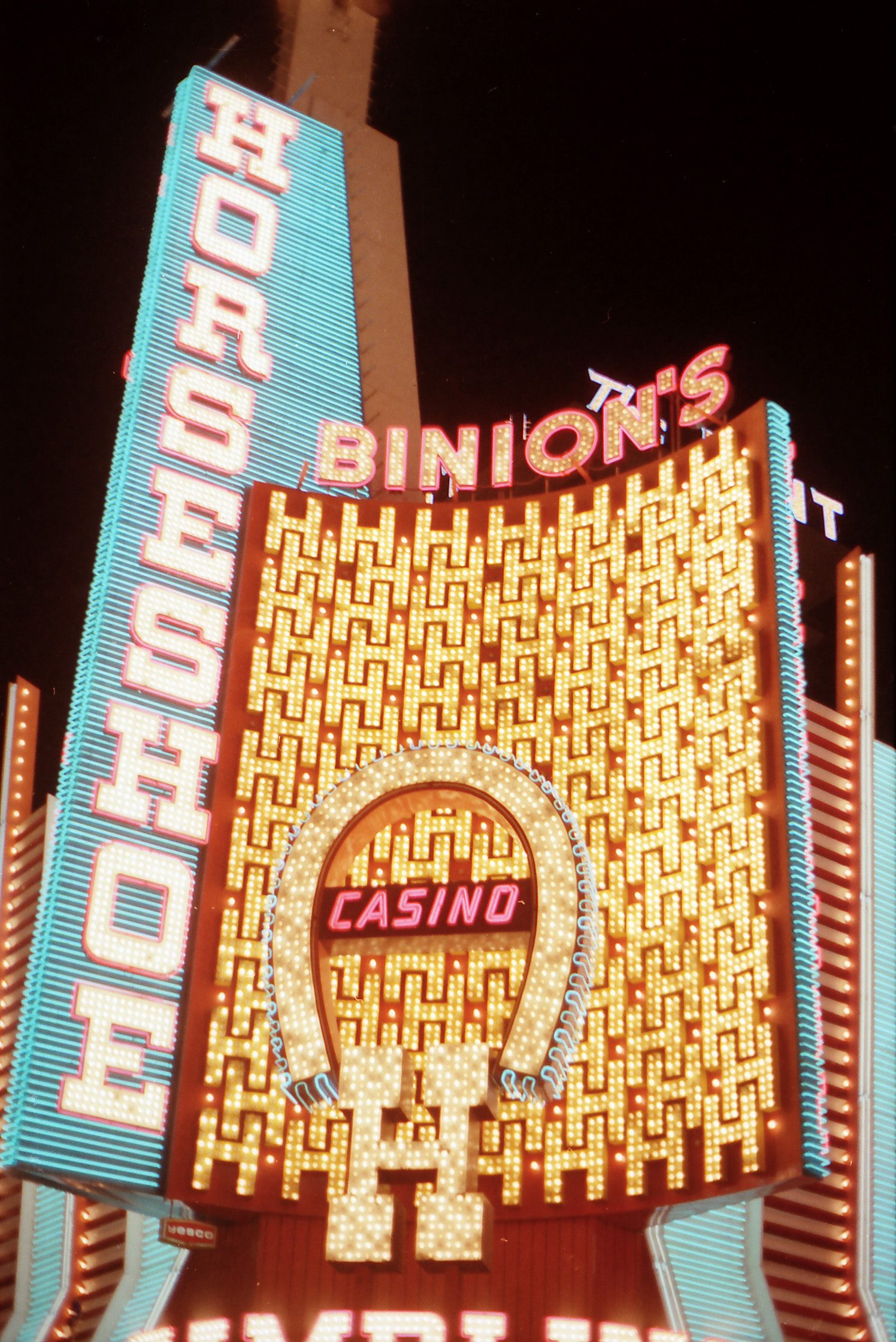
In 1951 Binion bought the Eldorado Club and the Hotel Apache on Fremont Street and reopened the combined property as Binion's Horseshoe, according to Wikipedia. His pitch to gamblers was simple and it worked: table limits ten times higher than anywhere else on the street, free drinks, and a horseshoe stuffed with cash bolted to the wall so tourists could pose next to it. The Horseshoe became one of the anchors of Glitter Gulch, the cluster of Fremont Street casinos that made downtown Las Vegas the city's gambling capital before the Strip took over that title.
The birthplace of the World Series of Poker
In 1970 Binion turned his casino into the birthplace of competitive poker, hosting the first World Series of Poker as a small invitational tournament. It grew into the largest set of poker tournaments on earth, and every bracelet handed out since traces back to a card table inside that Fremont Street building.

Eight miles of neon, thirty thousand bulbs
The sign that made the Horseshoe impossible to miss on that street came in 1961, when YESCO designers worked with architects Wayne McAllister and William Wagner on a redesign that wrapped the casino in more than eight miles of neon tubing and roughly 30,000 lightbulbs, according to the Neon Museum. Bold block letters rimmed in incandescent bulbs, topped with a glowing horseshoe. A slice of that original wall, the freestanding letter H, already lives inside the museum's Neon Boneyard.
The Horseshoe kept growing. In 1988 it acquired the neighboring Mint Hotel and Casino, connecting the two properties and commissioning a new sign designed through a collaboration between YESCO and sign designer Rudy Crisostomo. That 1980s-era Horseshoe sign is the one the Neon Museum is bringing back to life this year, part of a 2026 relighting calendar that has already restored the Mirage's lagoon sign and pulled the Siegfried and Roy tiger sculpture out of the Mirage's rubble, according to the Neon Museum's own announcement.
Where old Las Vegas goes to stay legible
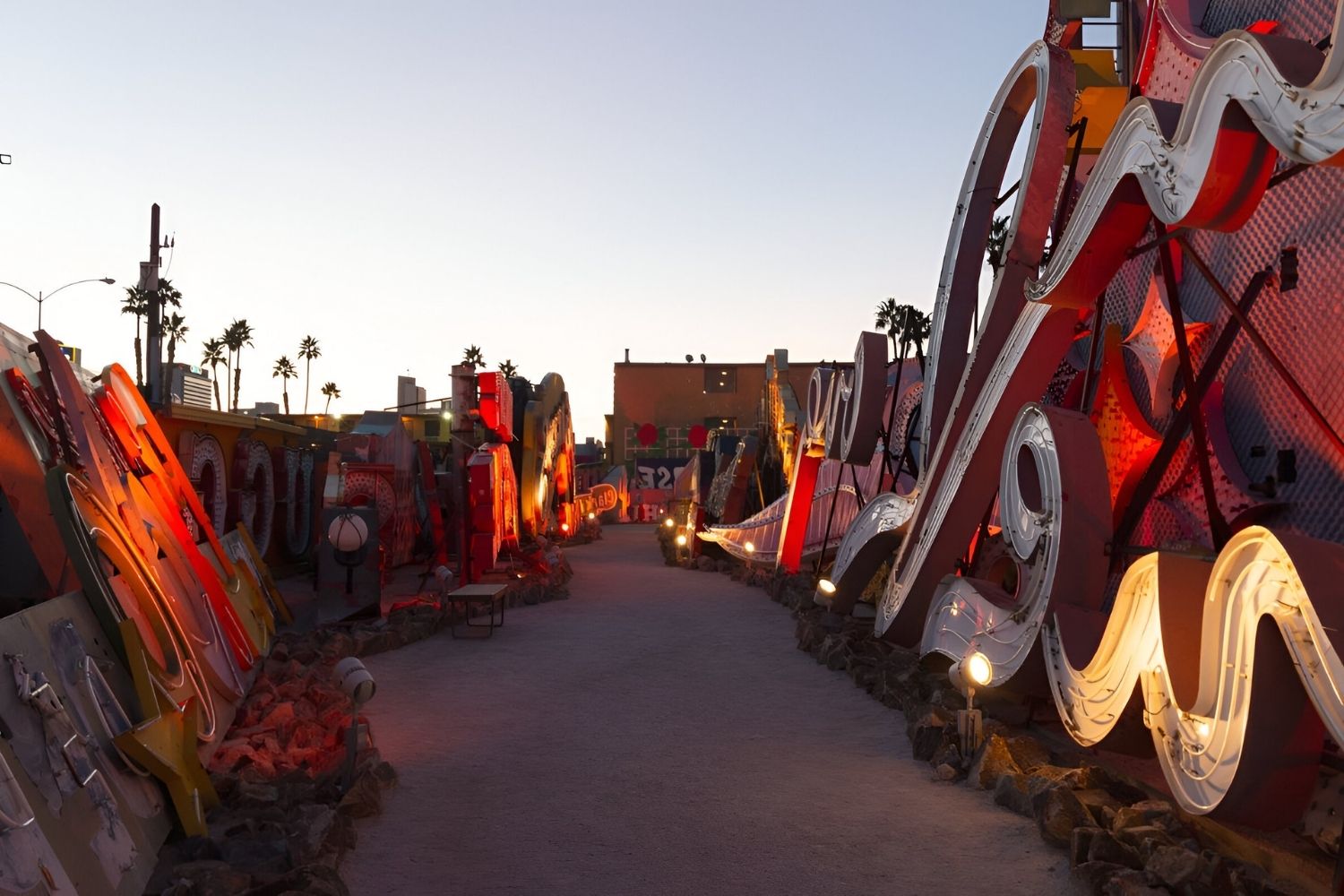
Casino signs in Las Vegas rarely retire gracefully. When Fremont Street closed to car traffic in 1994 and went under a pedestrian canopy built for shade and a nightly light show, some of the street's rooftop signs stayed protected under that structure, like Vegas Vic, the cowboy who has waved at tourists since 1951, per the Neon Museum's own history of Fremont Street. Plenty of others did not survive the changeover intact and got scrapped for parts or melted down when their casinos closed or rebuilt. The Neon Museum exists because a handful of preservationists decided Las Vegas's own visual history, the typography and glass tubing that built the city's image before anyone in town had heard of a mural or a stencil, deserved a second life instead of a landfill. The Boneyard now holds more than 250 unrestored signs alongside a smaller group of fully restored ones that stay lit around the clock. Binion's Horseshoe sign has spent years sitting in that unrestored pile, visible to tour groups by daylight and dark after the sun goes down.

Turning it back on
The museum has set the Binion's Horseshoe relight for December 1, 2026, with member presale tickets running October 16 through 22 and public tickets opening October 23, according to Coyote Country. The Horseshoe name itself has had a stranger fate than the sign. Binion's family lost the rights to the Horseshoe brand in a later sale, and the family casino that still operates on Fremont Street today runs simply as Binion's Gambling Hall and Hotel, while the Horseshoe name moved on to a chain of casinos with no address anywhere near Fremont Street. The neon coming back to life this winter has outlasted the name it used to spell.
The Binion's relight isn't a standalone event. It's one stop on a full year of them. The Neon Museum's 2026 calendar also includes the Mirage lagoon sign, an artifact from the 2023 Las Vegas Grand Prix, and the tiger sculpture that used to guard Siegfried and Roy's Mirage habitat, all part of a push the museum has described as honoring the resorts, entertainers, and moments that shaped the city. Stack them together and the pattern is obvious: as the Strip keeps imploding old resorts to build new ones, the Neon Museum has become the place where the old versions of Las Vegas go to stay legible, one relit sign at a time.
That matters more for the Horseshoe than for most. The building on Fremont Street is still standing and still open, but almost nothing about the way it announces itself to the street resembles the version Benny Binion built. The sign is the only piece of that version still capable of being switched back on exactly as it was, and this December, for one night, downtown Las Vegas gets to see it that way again. Downtown Las Vegas built its whole identity on signage doing the work that murals and stencils do in other cities, grabbing a stranger's eye from a block away and making a building impossible to forget from then on. The Horseshoe relight is a reminder that neon got there first, and that Fremont Street was running the same game the Arts District runs today, just with tubes of gas instead of spray cans.
Related reading from TasteBueno
- A 3,600-Pound Bronze Tiger Guarded the Mirage for 31 Years. Now It Lives in a Boneyard While a Guitar Rises Where It Stood.
- The Mirage Volcano Erupted for 34 Years on the Strip. Its Pieces Just Started Coming Back to Life Three Miles Away.
- A Las Vegas Museum Got Tagged on Opening Night. Its Fix Was to Charge Admission to the Free Street Party Next Door.
0 comments