

Banksy has a signature move: paint something that feels brand new, then let a journalist point out that a Frenchman already did it, twenty years earlier, in a country Banksy has never claimed to visit for the work. Banksy knows it. He's said so, on the record, more than once.

A rat that's really an anagram for art
In 1981, a young Parisian named Xavier Prou started stenciling rats onto walls all over the city. He signed the work Blek le Rat, a name borrowed from a Franco-Belgian comic strip called Blek le Roc. The swap wasn't random. Rearrange the letters in "rat" and you get "art." Prou called the rat "the only free animal in the city," one that "spreads the plague everywhere, just like street art," according to Wikipedia's account of his career. He'd studied fine art and architecture at the Beaux-Arts in Paris and spent time in New York in 1971 watching subway cars disappear under tags. Stencils were his answer to what he saw there: fast, repeatable, precise, and impossible for police to catch him mid-stroke. Within a few years he'd moved past rodents into something almost nobody in street art had done at scale before him. He started cutting entire human figures, life-size, stepping straight out of the brick. Forbes credits him as the artist who popularized the life-size stencil, a technique now standard from Bristol to Brooklyn to every laser-cut sheet a stencil shop ships out today.
A judge let him walk for stenciling a Madonna
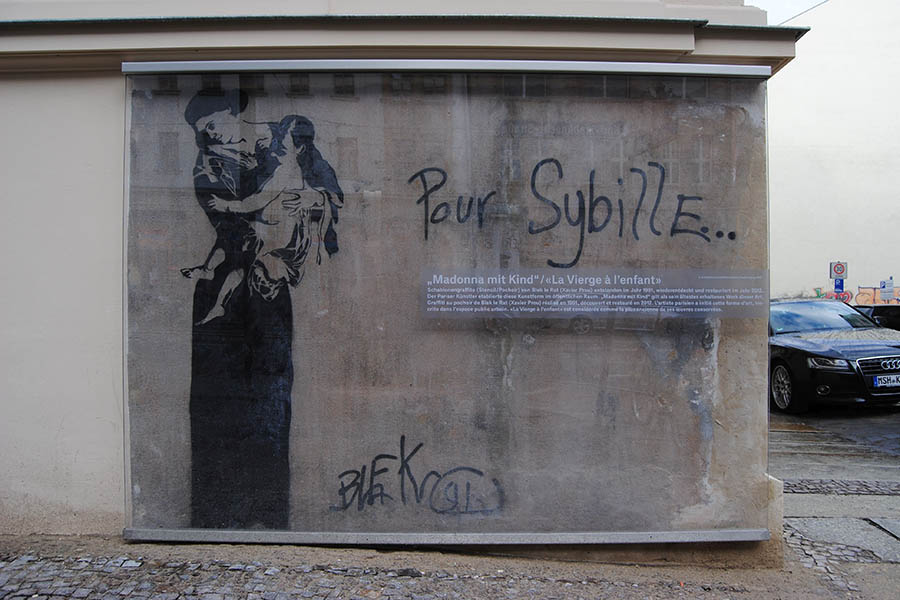
In 1991, Paris police finally caught up with him over a stencil replica of Caravaggio's "Madonna and Child," painted on a wall as a dedication to his future wife, Sybille. The case went to court on a property damage charge. The judge looked at the piece, liked it, and declined to convict him, according to GraffitiStreet's rundown of his career. Blek treated the near-miss as a warning anyway. He switched from cutting stencils freehand on site to carrying pre-cut templates he could slap up and clear out from in under a minute, cutting his arrest risk without slowing down how much work he put on the street.
The homeless series that raised the stakes
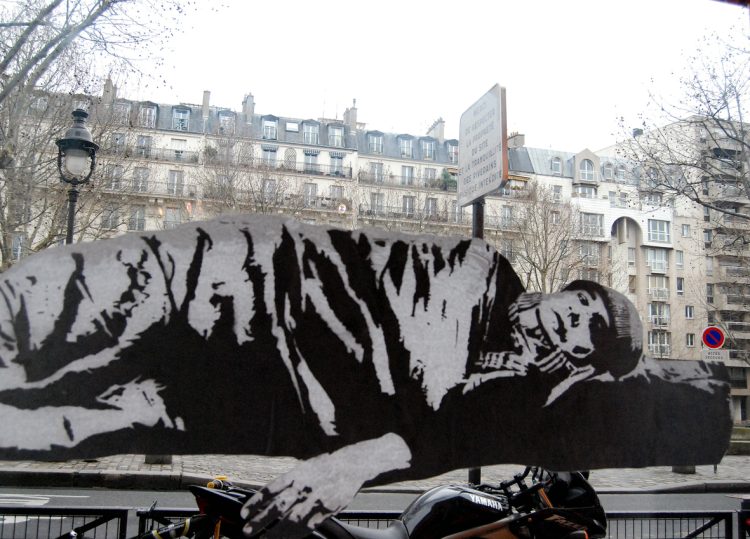
By 2006 he'd turned the same technique on a harder subject. He started stenciling homeless figures directly onto sidewalks and walls: people standing, sitting, curled against a curb, rendered at full human scale so nobody walking past could pretend not to see them. The series was built to make foot traffic reckon with a problem cities are good at looking past, per the same GraffitiStreet account. It's the part of his catalog that keeps getting dragged back into the conversation whenever critics line his work up next to a much more famous artist's homeless and refugee imagery, painted a couple decades later and an ocean away.
Banksy said the quiet part out loud
That much more famous artist eventually admitted the resemblance wasn't a coincidence. "Every time I think I've painted something slightly original, I find out that Blek le Rat has done it as well. Only twenty years earlier," Banksy said, a line recorded on Blek's own Wikipedia page and repeated in nearly everything written about either artist since. When Blek started stenciling rats in 1981, Banksy was reportedly still in grade school. Two decades later, Banksy was stenciling his own rats across London, using a technique Blek had already spent twenty years refining in Paris.
The old man stopped being generous
Blek didn't start out bitter about any of it. "People say he copies me, but I don't think so. I'm the old man, he's the new kid, and if I'm an inspiration to an artist that good, I love it," he said early on, a line captured by Art Lounge International's look at the rivalry. That generosity didn't survive contact with the documentary "Graffiti Wars," where Blek's tone flipped entirely: "When I see Banksy making a man with a child or Banksy making rats, of course I see immediately where he takes the idea. I do feel angry." He went further, openly questioning Banksy's integrity and suggesting it might be time for him to show his face. Banksy never took him up on it. Every home-cut stencil sold today, every life-size figure sprayed onto a wall in one clean pass, still runs on the trick Blek le Rat proved in a Paris alley in 1981. His name is the one that ends up in the footnote. The auction headline still goes to the guy who came twenty years later.

0 comments