

The Las Vegas Arts District did not have a plan. It had cheap rent, empty warehouses, and artists who painted whatever they wanted on the walls because nobody who owned the buildings cared. Twenty years later, the city is putting that same wall art into the building permits.
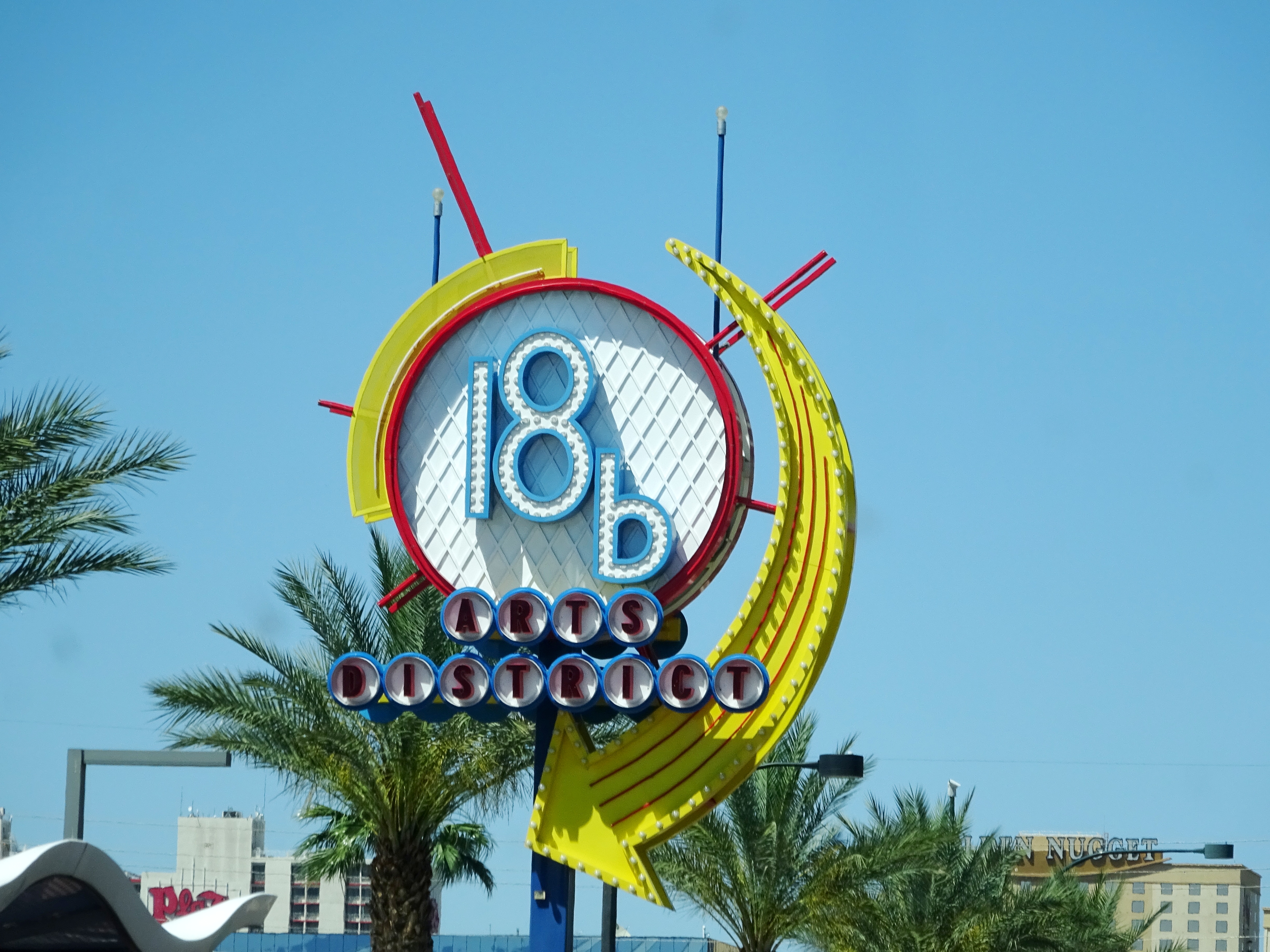
In March 2026 the Las Vegas City Council approved a six-story apartment building at 7th Street and Gass Avenue, wedged between the 18b Arts District and the historic Huntridge Theatre. City staff had initially recommended denial, worried the parcel was being overbuilt. The council approved it anyway, on a motion from Councilwoman Olivia Díaz, after architect Sheldon Colen reworked the design to add street trees, ground-floor businesses, and public murals painted by local artists. Not murals as a nice idea. Murals as a condition of the permit.
The neighborhood that used to be nobody's business
The Arts District, known locally as 18b, grew up in the shell of downtown Las Vegas that the casinos left behind. Warehouses on Main Street and Casino Center Boulevard sat half-empty through the 1990s and 2000s. Artists moved in because nobody else wanted the square footage. First Friday, the monthly art walk that now pulls crowds along Boulder Avenue and 1st Street, started as a handful of galleries opening their doors on the same night. Nobody was zoning it. Nobody was requiring anything. The murals showed up because the artists were already there and the walls were free.

That history is why a city council writing "public murals by local artists" into a construction approval is a genuinely new thing. The Arts District Plan, the city's own framework for the neighborhood, states its goal in plain terms: retain the artists and creatives who built the district's identity before the district's identity gets sold back to people who never painted a wall in it. The city is also pursuing a live/work housing partnership with the nonprofit Artspace, aimed at the same problem: keep the people who made the neighborhood valuable from getting priced out of it.
The money moving in is not small
The 7th and Gass approval is one project. The bigger number is Flats Arts District, a joint venture between Chicago-based CEDARst Companies and Bridge Investment Group. It is 311 apartment units on 2.3 acres, a $112 million project, with first units delivered by mid-2026. Add in Southern Land Co.'s new rental project at California Avenue and Third Street, and Midtown Las Vegas breaking ground on hotel rooms and retail nearby, and the Arts District is absorbing more capital in one construction cycle than it saw in its first two decades combined.

None of this is happening quietly. At a community meeting held at The Strat in March 2026, John Watkins of Centennial Advisors called the area "the last key stone to bringing the Strip and the Arts district together," which is exactly the kind of sentence that makes longtime residents nervous. LVMPD Downtown Area Command Captain Adam Seely told the same room that violent and property crime had dropped roughly 40% over two and a half years under the department's Safe Village initiative. Casa de Luz nonprofit director Maggie Clark talked about keeping families stable through the change rather than after it. The subtext at every table was the same: the neighborhood is about to be worth a lot more, and the people who made it worth anything might not be the ones who benefit.
Murals as a permit condition, not a favor
Requiring murals sounds like a win for artists on paper. In practice it changes who is doing the choosing. For thirty years, a wall in the Arts District got painted because an artist asked a landlord who did not care, or just did it. Now a wall gets painted because a redevelopment agency wrote it into an approval, an architect specced it into a rendering, and a developer budgeted it as an amenity line item next to the rooftop deck and the smart-home locks. The paint is the same. The person deciding whose art goes up is not.
That shift is not unique to Las Vegas, and it is not automatically bad. A commissioned wall pays an artist real money, on a real timeline, with real materials, which beats painting for free on a warehouse that gets demolished in five years. But it is a different economy than the one that built 18b, and the artists who are still there know it. The murals that made the Arts District a destination were not curated. The murals that are about to define its next chapter will be, because a $112 million project does not leave its ground-floor art to chance.

What happens to the version that grew wild
The Arts District still has the murals nobody commissioned: tributes painted after a death, political pieces nobody asked permission to put up, a wall that changes because someone with a can and an opinion decided it should. Those are harder to build into a zoning approval, and they are the reason the neighborhood got interesting in the first place. If the city's own goal is to retain the artists, not just their output, the test is not whether the new towers have murals on the ground floor. It is whether there is still a cheap wall somewhere in 18b that an artist can paint without asking anyone first.
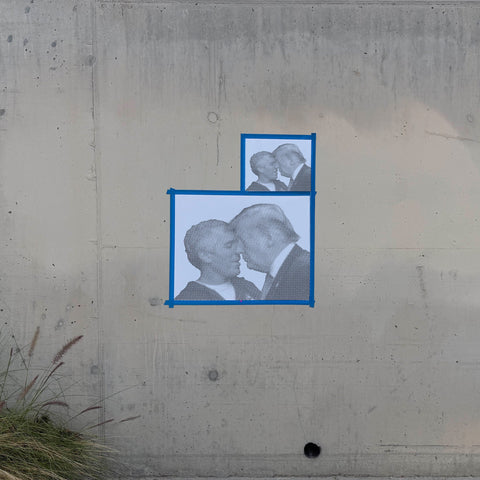
Anyone cutting their own designs for that wall, permitted or not, is working the same problem TasteBueno solves for stencil artists everywhere: turning an image into something you can actually put up fast, clean, and repeatable. If you're building your own file library instead of hand-cutting each one, the Stencil Library has hundreds of cut-ready halftone files for exactly that.
0 comments