

Two identical twins in São Paulo started drawing because it was the only way they had to talk to each other. Forty years on, the yellow-skinned characters they invented have flown on a Brazilian national team's Boeing 737 and wrapped six industrial grain silos in Canada.
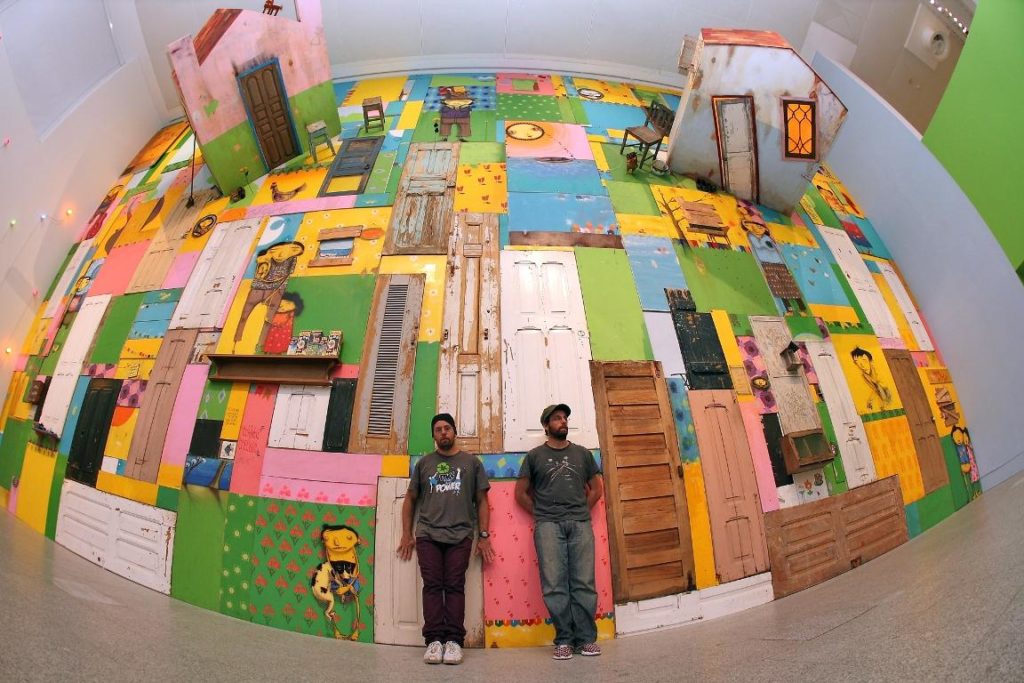
Cambuci, not a scene
Otavio and Gustavo Pandolfo, born in 1974 and known worldwide as OSGEMEOS, Portuguese for "the twins," grew up in Cambuci, a working-class neighborhood in São Paulo, according to Wikipedia. Drawing was play before it was art, and it was how the brothers talked to each other and to their family. In the 1980s they got pulled into Brazil's emerging hip hop culture, first through breakdancing, then through graffiti. They painted their first pieces on city walls in 1987.
There was no scene to plug into and no supply chain to lean on. Brazilian spray paint at the time was expensive and low grade, so the twins improvised their own materials and, out of that same scarcity, their own visual language. That constraint is a large part of why OSGEMEOS looks like nothing else that came out of the same decade. Their first real influence from outside Brazil didn't arrive until 1993, when American street artist Barry McGee spent several months in the country.

Why everyone in their world is yellow
Every character OSGEMEOS paints shares the same jaundiced skin tone, and it reads as theirs from a hundred feet away before you clock a single other detail. The twins trace the color to their own dreams, and to something more literal: sunlight coming through the windows of the room where they drew as kids turned the whole studio yellow. Critics have called the resulting work "escapist fantasies" and compared its dreamlike, patterned style to Hieronymus Bosch and M.C. Escher, per Wikipedia. Whatever the source, it became a signature nobody else could fake.
From Coney Island to Tate Modern
The murals started stacking up internationally through the 2000s. In 2005, as part of the Dreamland Artist Club project, OSGEMEOS painted a 130-foot mural in Coney Island. Three years later, in 2008, they painted six large-scale murals on the exterior of Tate Modern in London, on view for three months alongside five other acclaimed street artists brought in for the same show.
The pair's rise also tracks the broader boom in Brazilian street art exports. São Paulo's graffiti scene spent decades developing in relative isolation from the galleries of New York and Europe. OSGEMEOS became one of the clearest cases of that local language traveling outward instead of importing someone else's.
A national team's airplane and six grain silos
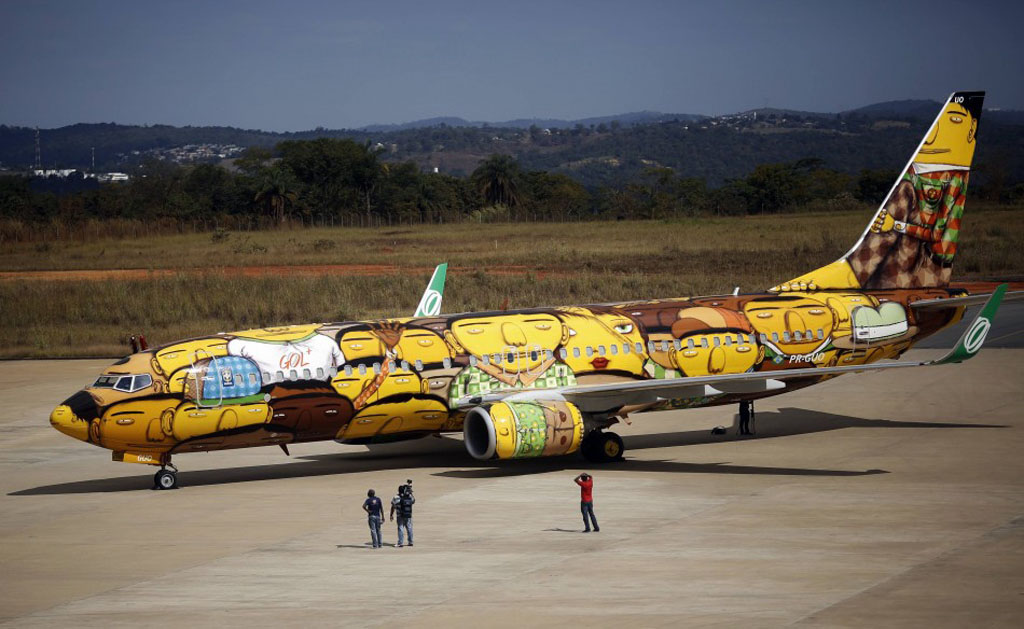
By 2014 the commissions had scaled up to absurd. For that year's FIFA World Cup in Brazil, OSGEMEOS were hired to decorate the Brazilian national football team's official Boeing 737, covering the plane in imagery built around the country's cultural diversity using more than 1,200 cans of spray paint. The same year, the twins finished "Giants," their largest piece to date: six industrial grain silos in Vancouver, wrapped for the Vancouver Biennale and paid for entirely through crowdfunding.
The scale kept climbing from there. In 2024, the Hirshhorn Museum and Sculpture Garden in Washington, D.C. opened "OSGEMEOS: Endless Story," a yearlong, full-floor survey bringing together roughly 1,000 works, photographs, and archival materials, according to Colossal. It ran from September 2024 through August 2025 and stands as the largest U.S. exhibition of their work to date.

The constraint that became the style
Most artists spend years chasing a signature. The Pandolfo twins had theirs handed to them by scarcity. No good spray paint meant inventing their own approach. No local scene to copy meant no outside reference until McGee showed up in 1993. Everything downstream of that, the airplane, the silos, the Hirshhorn floor, traces back to two kids in Cambuci drawing because it was the only language they both spoke fluently.
Related reading from TasteBueno
- KAWS Learned to Rob Bus Shelters in San Francisco in 1995. Thirty Years Later, SFMOMA Gave Him the Roof.
- Invader Just Covered a Paris Concert Hall in Daft Punk's Robot Heads. You Need an App to Find Them All.
- Damien Hirst Spent 30 Years Preserving Sharks in Tanks. His Newest Show Put a Space Invader in One.

0 comments