

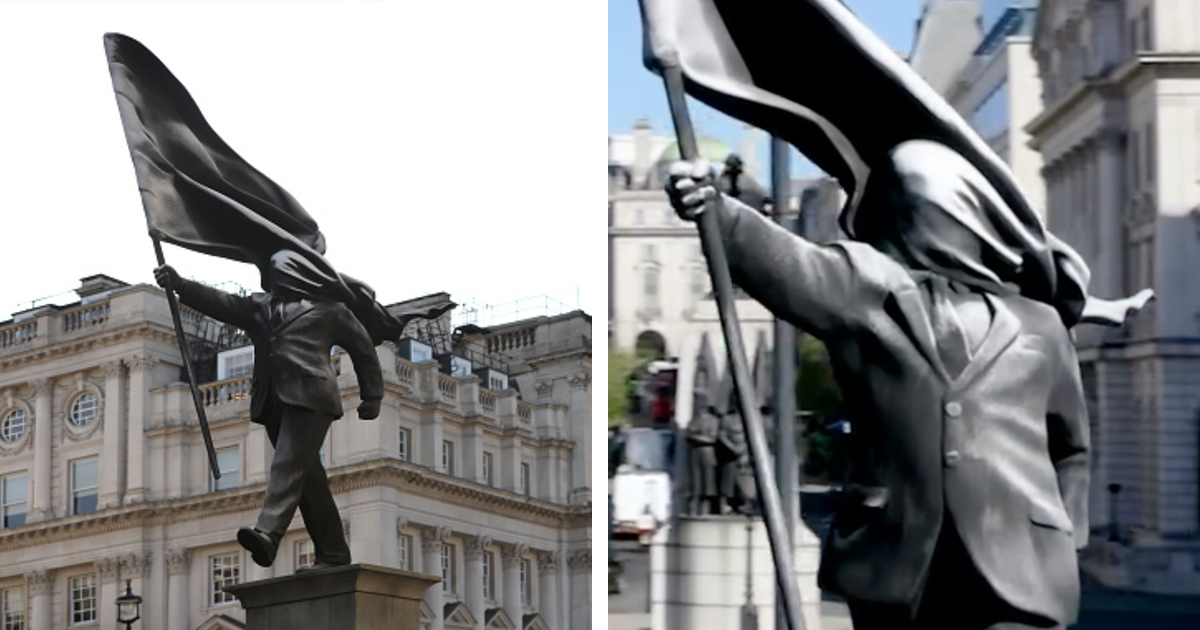
A new wave of shock swept through London this week as a mysterious figure emerged in bronze and stone on Waterloo Place, revealing Banksy's latest provocative statement. A man stepping down from a plinth, his face hidden by the whipping flag in his hand, challenges the city's historical narratives with a powerful visual metaphor.
Reporting via en.wikipedia.org bbc.com.
Waterloo Place, already brimming with monuments to Britain's imperial past, now hosts an unsettling intervention that forces viewers to confront uncomfortable truths. Banksy's statue is not just another piece of street art; it disrupts the celebratory tone set by existing structures and demands prolonged consideration.
A Physical Manifestation of Discomfort
Banksy's decision to work in bronze and place this statue within London's formal landscape marks a significant departure from his usual practice. While stencil graffiti often thrives on impermanence, this sculpture is meant to endure and provoke reflection. The material choice transforms the fleeting moment into a lasting statement.
The depiction itself is rich with symbolism: the man's suit suggests respectability, while the flag obscures his face, symbolizing how ideology and nationalism can blind us to uncomfortable truths. This visual commentary on power manipulation is both pointed and poignant.
Art dealer Philip Mould noted that Banksy "got the proportions perfectly right" according to BBC News. The precision emphasizes the statue's connection to monumental forms, highlighting the absurdity of placing this figure within that historical lineage.
Context: Waterloo Place and Imperial Memory
Waterloo Place was deliberately designed in the 1800s as a space for celebrating imperialism and military dominance as reported by BBC News. Flanked by statues of Edward VII, Florence Nightingale, and the Crimean War Memorial, this area embodies British expansion and its perceived triumphs. Placing a work that critiques these narratives is a bold and pointed act.
The surrounding monuments aren't just historical relics; they continue to shape public perception, reinforcing narratives of national exceptionalism and imperial benevolence. Banksy's statue disrupts this comfortable narrative, forcing viewers to consider the darker side of those historical representations.
The Anonymity Factor: A Consistent Practice
The installation appeared overnight on 29 April 2026 as confirmed by Wikipedia, perfectly in line with Banksy's established methodology. This surprise element reinforces the sense of disruption and shock integral to his art practice.
Banksy's anonymity allows the work itself to take center stage without celebrity distraction. The signature on the plinth is a deliberate marker, a wink to those familiar with his style, but also a defiant claim of authorship that remains elusive and indirect.

Reception: Official Approval & Critical Analysis
The response from Westminster City Council has been predictably cautious. They described the work as a "striking addition" according to BBC News, attempting to frame it within the context of London's public art scene. This reaction reveals the inherent tension between institutions and disruptive artistic interventions.
Critics, however, are more forthright in their assessments, labeling it an "anti-imperialist monument" as noted by My Modern Met. They highlight its questioning of power structures and the narratives embedded within public monuments. The statue is not simply decorative; it interrogates.
Beyond the Image: A Wider Conversation
This isn't just about one statue in London; it's part of a broader debate on historical memory, representation, and imperial legacies. Banksy rarely offers easy answers but instead poses difficult questions.
The placement near figures like Edward VII and Florence Nightingale demands a re-evaluation of their roles in history, prompting viewers to consider perspectives often excluded from official accounts. The work invites an examination of how public spaces shape collective memory and reinforce power dynamics.

Confirmations & Social Media
Banksy confirmed his involvement on 30 April through a post on Instagram, sharing a video of the installation as documented by Wikipedia. This online announcement serves as both validation and another layer of strategic communication.
Social media plays a crucial role in disseminating Banksy's work, amplifying its message beyond traditional art circles. The immediacy of the image, the man struggling against the flag, resonates quickly, sparking conversations and generating widespread attention.
A Lasting Impact?
The long-term impact of this statue remains to be seen. Will it lead to a reassessment of Waterloo Place's monuments? Will it inspire further interventions challenging historical narratives in public spaces? These are open questions.
.jpg/1280px-Banksy_statue_in_Waterloo_Place_(cropped).jpg)
One thing is certain: Banksy's presence continues to provoke thought and challenge complacency, reminding us that even the most seemingly permanent structures can be questioned and reimagined. The city's response will reveal more about how London grapples with its history than any single artwork ever could.


0 comments