

The sheer scale of Adam Cvijanovic's new mural in St. Patrick's Cathedral hits you the moment you step inside, towering over everything else and commanding your attention. It isn't just a decorative piece; it's a powerful visual declaration about faith, migration, and belonging, all captured on an enormous canvas that dwarfs its surroundings. This project marks a significant milestone for one of New York City's most iconic religious landmarks.
Reporting via catholicworldreport.com catholicworker.org.
For over 146 years, St. Patrick's Cathedral has stood as a spiritual anchor in the city, drawing together generations influenced by Irish immigration and subsequent waves of newcomers. The mural, the largest permanent artwork commissioned since the cathedral's construction, formally acknowledges these changing demographics and continues to serve as a sanctuary for those seeking refuge. Cardinal Dolan emphasized its significance, calling it "an ode to Jesus" and a tribute to those who have found sanctuary here as reported.
The Weight of History
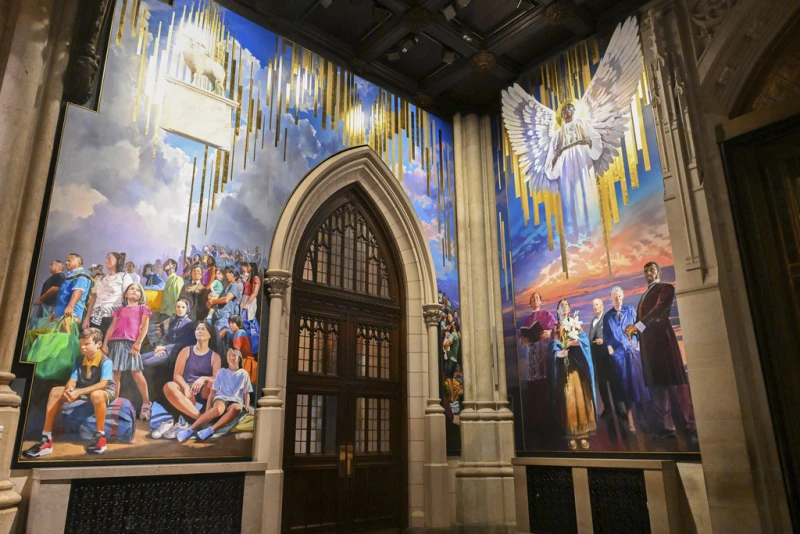
The mural's core narrative centers on the 1879 Apparition at Knock in Ireland, a pivotal moment when the Virgin Mary and Saint Joseph appeared to local villagers. This event deeply resonates within Irish-American communities across New York City, symbolizing divine intervention during times of hardship, a recurring theme for those who have traveled here seeking opportunity or escaping persecution. By including this historical moment, Cvijanovic visually connects the faith of past generations with the ongoing experiences of contemporary immigrants.
Street art often responds to its environment, but few spaces are as steeped in history and tradition as St. Patrick's Cathedral. Cvijanovic navigated these complexities by ensuring his work had both artistic merit and theological resonance. The choice to portray the Knock apparition acknowledges the deep roots of faith within this city's Irish diaspora while simultaneously opening space for newer stories.
Portraits of People
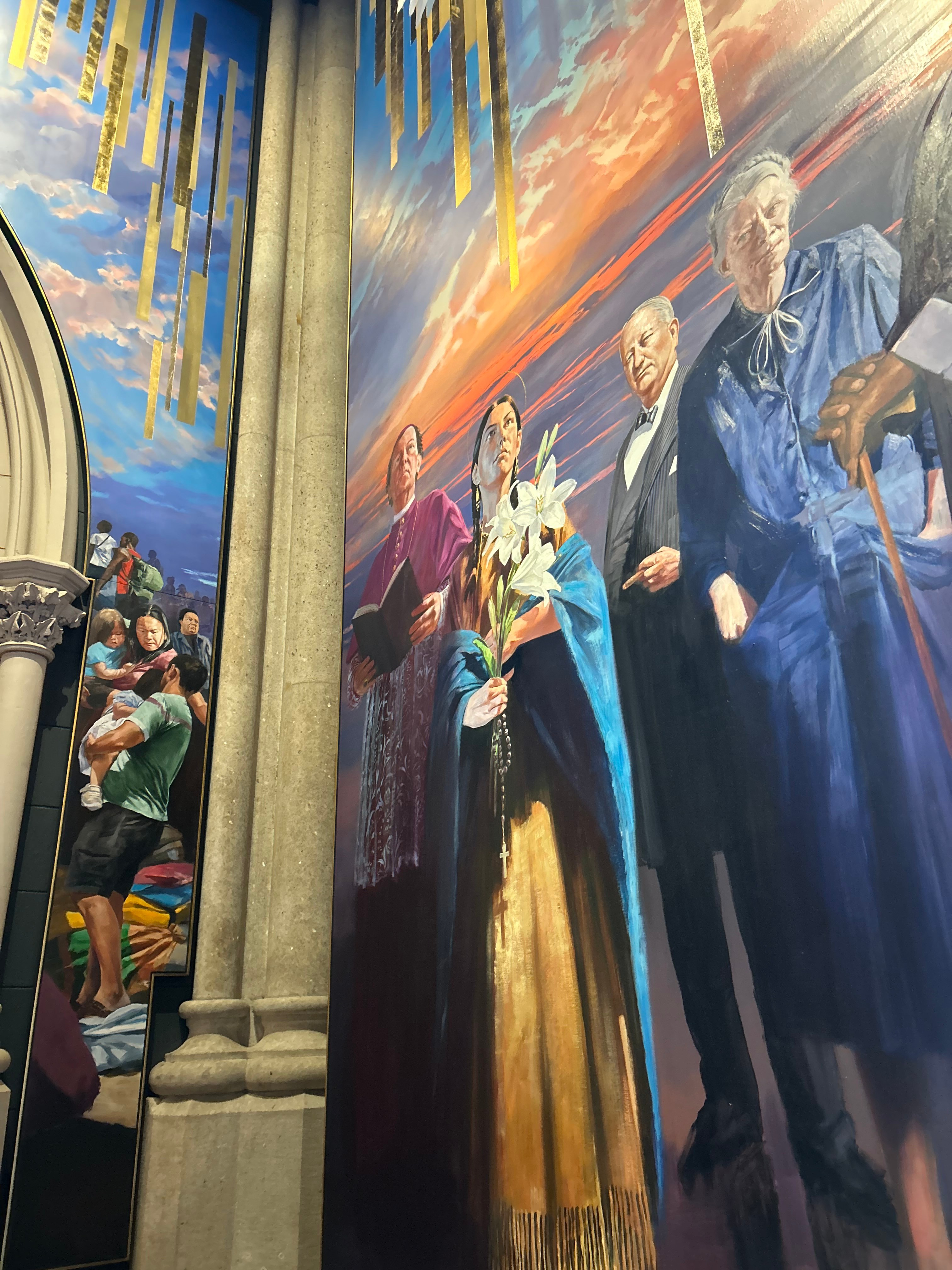
Cvijanovic emphasized that he wanted to create something centered on individuals, as stated in his interview according to the report. Every figure in the mural is a portrait, elevating them from anonymous representatives of larger groups. This approach humanizes the narrative, grounding it in specific stories and experiences rather than abstract ideals.
The focus on individual faces provides a powerful counterpoint to the grand scale of the work itself; you are forced to confront the humanity within this monumental composition. Recognizable figures like Dorothy Day, Pierre Toussaint, Alfred E. Smith, and Kateri Tekakwitha reinforce the idea that faith is lived through individuals in acts of service and sacrifice. It's a reminder that even institutions as imposing as cathedrals are built on the contributions of ordinary people.
Immigration's Journey
A particularly poignant panel depicts immigrants disembarking from an ocean liner, arriving in New York City. This image directly links the Knock apparition to the broader experience of migration, capturing the hope, uncertainty, and faith that accompany journeys across oceans and cultures as noted. It speaks to a recurring theme in the city's history: waves of newcomers seeking refuge and opportunity.
The mural doesn't shy away from acknowledging the hardships inherent in such journeys; it acknowledges struggle alongside triumph. This aligns with many street art movements, which often give voice to marginalized communities and challenge dominant narratives, a quality that feels surprisingly at home within a sacred space.
First Responders and Saints
The inclusion of five New York City first responders alongside exemplars of Catholicism is another key element of the mural's design. These figures represent contemporary acts of service and sacrifice, reflecting the cathedral's commitment to both spiritual care and civic responsibility. The depiction of an angel as a young man of African descent adds further layers of meaning.
This juxtaposition subtly redefines what it means to be a "saint" in the modern era; holiness isn't confined to historical figures or religious icons but is also reflected in those who dedicate their lives to protecting and serving their communities. It challenges viewers to consider how acts of everyday heroism can embody spiritual values.

A Delayed Vision
Cardinal Dolan expressed that he originally envisioned this mural much earlier, during the last major renovation of St. Patrick's Cathedral in 2012 as mentioned. The trustees' decision to postpone the project highlights the complexities of balancing artistic ambition with institutional constraints.
The delay ultimately allowed for a more considered and impactful work, one that resonates with contemporary concerns about immigration and social justice. It shows that even within established institutions, there is room for evolution and adaptation, a willingness to engage with changing cultural landscapes. The final result speaks to the enduring power of faith and its ability to inspire both artistic expression and community engagement.
Rector's Reflection
Father Enrique Salvo, rector of St. Patrick's Cathedral, offered a personal reflection on his own journey as an immigrant from Nicaragua as he stated. His story epitomizes the themes explored in the mural, serving as a living testament to the transformative power of faith and perseverance.
His words underscore the cathedral's role not only as a place of worship but also as a symbol of welcome and opportunity for those seeking refuge in this city. The dedication ceremony on September 21st, 2025, marked not just the unveiling of a stunning work of art, but also an affirmation of New York City's enduring commitment to its immigrant communities according to reports.

0 comments