

Loss leaves a mark, altering the landscape of one's life and reshaping their vision entirely. Damon Neal understands this intimately after navigating unimaginable grief following his brother's death from COVID last July and his father's heart attack in January. He is translating that personal experience into something monumental: a mural at Dallas Indian United Methodist Church.
The project began as an exploration of representation, a question posed by Rev. J.B. Jackson, how would the Dallas Indian community perceive Christ portrayed differently? This inquiry quickly expanded beyond traditional depictions to incorporate elements of creation and reflection on indigenous spirituality, inspired by Neal's artistic process and a shared reading of Katie Dawson's 'All Earth is Waiting: Good News for God's Creation'. It is an ambitious undertaking that promises more than just decoration.
A Personal Journey Through Grief
Damon Neal's mural project emerged from a deeply personal space. He lost his brother to COVID last July and his father died of a heart attack in January, two devastating blows within a short period. The process of creation became an essential part of the healing journey, allowing him to channel immense pain into something tangible and meaningful.
The mural's genesis speaks to the power of artistic expression as a form of therapy. It's not uncommon for artists, especially those working within community-focused practices, to use their work to confront personal struggles while simultaneously contributing to collective healing. Neal's willingness to open this process up within a church setting suggests a desire for connection and shared vulnerability, qualities that resonate deeply with the local community.
'Window to Heaven': A Sensory Experience
The mural, titled 'Window to Heaven', is designed to engage all five senses. This concept directly reflects the belief that God's voice works through every sensory experience, moving beyond traditional visual representations of faith. It represents an attempt at creating an immersive spiritual environment where viewers can connect with their beliefs on multiple levels.
The choice to incorporate all five senses in the mural's design is significant within the context of contemporary art and spirituality. Many artists are moving away from purely visual forms, exploring sound, touch, smell, and even taste to create more complete and engaging experiences for audiences. This approach reflects a broader shift toward holistic practices aiming at a deeper connection.
Replacing Tradition with Indigenous Representation
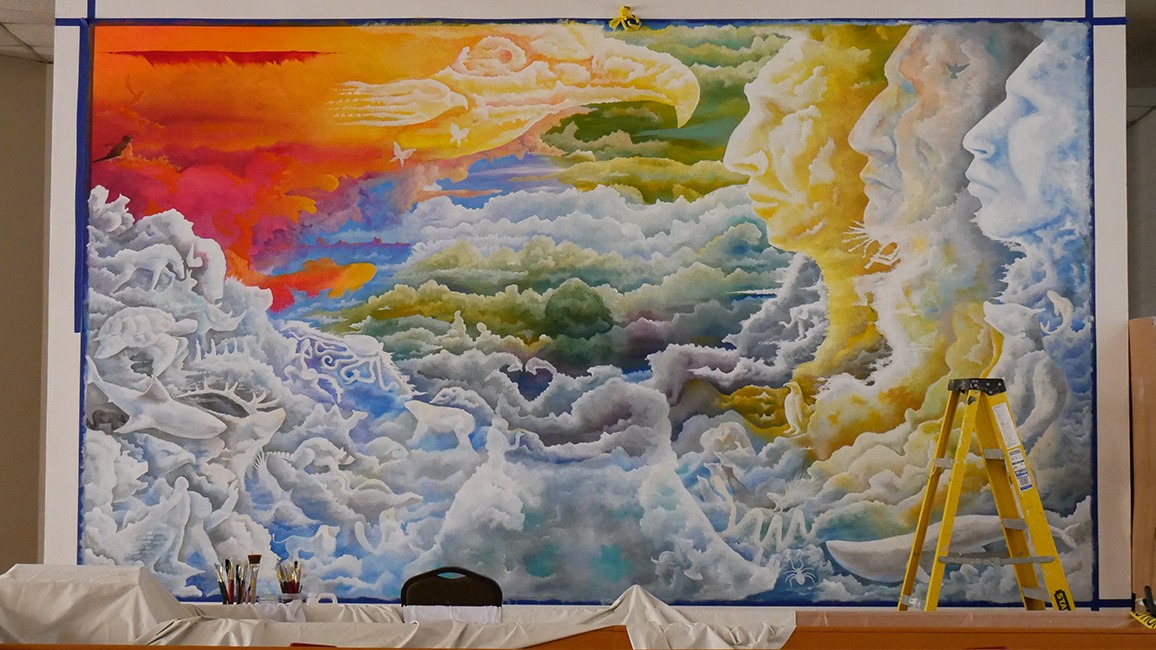
Neal's 20-foot by 25-foot mural now occupies the space previously held by a depiction of the Last Supper featuring a pale-faced Jesus. This act itself is symbolic, representing a deliberate shift away from traditional iconography toward indigenous representation and a reimagining of religious imagery within a Native American context.
Such substitutions often stir conversation about cultural appropriation and ownership within artistic spaces. While a pale-faced Jesus had its own historical significance, replacing it with Neal's creation signals an intentional effort to center indigenous voices and perspectives, reclaiming space and challenging established norms. This is particularly important given the history of colonialism and erasure experienced by Native American communities.
A Tapestry of Ancestry and Spirit
Damon Neal's identity weaves into the fabric of the mural itself. As a member of the Jicarilla Apache Nation, he carries heritage from his Apache mother and father and lineage from Cherokee, Wichita, Caddo, and Delaware ancestors. These diverse ancestral threads are reflected in the mural's imagery, creating a complex and layered representation of identity.
The inclusion of animals representing different tribes and people's spirit animals is particularly meaningful. This approach emphasizes a circular view of creation, central to many indigenous belief systems, rather than a linear one often found in Western thought. By incorporating these symbols, Neal invites viewers to consider the interconnectedness of all living things.
The Emergence of Creation
Neal's artistic process was guided by what he describes as the Holy Spirit. Animals and sea creatures kept appearing in the shapes of clouds as he painted, leading him to believe he should let divine influence shape his work even further. This openness to unexpected imagery demonstrates a willingness to relinquish control and allow for spontaneous creativity.
This element highlights an important aspect of many street artists' practice, trusting intuition and allowing the environment or community to shape their vision. Neal's experience mirrors how many artists find meaning in the unexpected, embracing serendipity as a catalyst for artistic innovation. It underscores the idea that art can be a conduit for spiritual guidance.
A Vision for the Future
Rev. Jackson's plans extend far beyond Neal's mural; he envisions transforming the entire church into a space showcasing Native American artists' work, filling all walls, the ceiling, and windows. This expansive project represents a commitment to cultural preservation and artistic expression within the Dallas Indian community.
This comprehensive approach is indicative of a growing movement toward decolonizing religious spaces, reclaiming them as centers for indigenous culture and spirituality. It suggests that places of worship can serve not only as sites of prayer but also as platforms for celebrating cultural heritage and promoting artistic innovation, ultimately creating a space where diverse voices are heard and honored. You can read more about this vision at NT Cumc News.
Beyond Representation: A Dialogue with Community
Rev. Jackson's initial inquiry about how the Dallas Indian community would react to different portrayals of Christ, including a 'Red Christ', points to a desire for dialogue and engagement. It reveals an understanding that artistic representation is not merely aesthetic but carries significant cultural and emotional weight.
This approach emphasizes the importance of artists as facilitators, fostering conversations within communities rather than simply creating objects for passive consumption. By inviting community response and critical reflection, Rev. Jackson's project aims to create a space for healing, understanding, and ultimately, a deeper connection to faith and culture. Learn more about the church's broader goals at NT Cumc News.

0 comments