

There is a man who has glued the same cartoon alien to walls in more than 80 cities, the deep end of Cancun Bay, and the inside of the International Space Station. Nobody outside a small circle knows his face. And roughly 482,000 strangers spend their free time hunting his work with a phone app, scoring points like it is a video game. The trick that turned a single pixel monster into all of that is simpler than it looks, and most brands miss it.

One alien, four thousand times

Invader started gluing ceramic tiles to walls in Paris in the late 1990s. The image was lifted straight from the 1978 arcade game Space Invaders: a blocky 8-bit alien, built from square tiles standing in for pixels. He did not invent a logo and run a campaign. He picked one borrowed shape and decided to put it everywhere.
By 2011 he had cemented his 1,000th piece in Paris. By January 2020 the count was 3,858 mosaics made of over 1.5 million tiles. In 2021 he hit the 4,000th. He calls the whole thing the Space Invader project, and each placement an "Invasion." The aliens now sit in more than 80 cities across the world, from New York and Hong Kong to Bhutan, and in places no other artist has reached.
The repetition is the point. One mark, made over and over in public, stops reading as graffiti and starts reading as a system. People learn the shape. Once they know the shape, they see it everywhere, and they start looking for it on purpose. That is the whole mechanism, and the rest of his career is built on it.
How an Invasion actually works

An Invasion is not one mosaic. It is a wave. Invader picks a city, then plants 20 to 50 pieces across it in a single trip, usually over two or three weeks of night work. He calls his site selection urban acupuncture: a piece goes where it will be seen and where it has a reason to be, not at random. He cuts and grouts the tiles in advance so the install on the wall takes minutes, not hours.
Then he documents the campaign. For each city he publishes an "Invasion map" cataloguing where every piece is. By early 2020 he had put out 24 of these maps. The map turns a scattered set of glued tiles into a numbered collection, and a collection is something people complete.
When a piece gets stolen or scraped off a wall, and many have, he sometimes goes back and installs it again. He calls this a reactivation. The number stays on the board. The collection stays whole. He is not just making art, he is running a database in public and keeping it accurate.
The app that made it a game
In 2014 Invader released FlashInvaders, a free phone app. You find a real mosaic on a real wall, photograph it through the app, and if it is a genuine piece you score points. There is a global leaderboard. As of recent counts the app has about 482,000 players.
This is the move that separates Invader from every other street artist. He did not just leave work for people to find. He built the scoreboard. The hunt has rules, points, and rivals, so finding a mosaic in a back alley in Lyon means something measurable. Half a million people now travel, detour, and look up at walls because of a borrowed arcade alien and a free download.
For a working artist this solves the oldest problem in street art at once. Street work is temporary and easy to ignore. Tie it to a game and the audience protects it, records it, and spreads it for free. The players are the marketing.
Off the wall: space and the seabed

In 2012 Invader went underwater. With the British sculptor Jason deCaires Taylor, who builds submerged sculpture parks, he fixed mosaics onto Taylor's statues on the floor of Cancun Bay in Mexico. To score those you need a diving mask.
Then he went up. On 12 March 2015, Italian ESA astronaut Samantha Cristoforetti installed an Invader mosaic, named Space2, on a wall of the Columbus module aboard the International Space Station. It is widely cited as the first artwork placed in space. The piece had to be lifted to orbit on a resupply mission first. Years later French astronaut Thomas Pesquet, who flew on the station, told Invader he was a fan and floated the idea of carrying a piece to the Moon.
Same alien, same logic, stranger addresses. The shape does not change. Only the wall does. That consistency is what lets a tile on a Paris doorway and a tile orbiting Earth read as the same project.
Rubikcubism
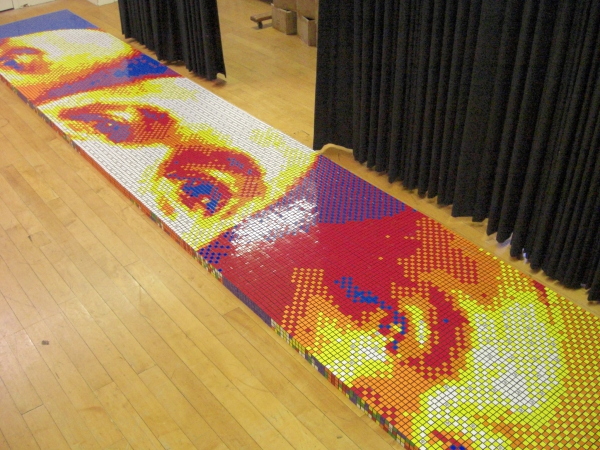
For galleries Invader runs a second body of work he named Rubikcubism, started in 2004. Instead of ceramic tiles he builds images out of scrambled Rubik's Cubes, using each colored square as a pixel. A typical piece uses around 300 cubes, runs about 0.9 by 1.3 metres, and weighs roughly 36 kilograms.
The series falls into groups: "Bad Men" of villains, "Masterpieces" that rebuild famous paintings in cube-pixels, and "Low Fidelity" album covers. The logic is identical to the street work. Take a low-resolution grid, treat each unit as a pixel, build a recognisable image. The Rubik's Cube is just a tile he can sell indoors. It also gives him a product to put on gallery walls without prying a mosaic off a building.
Stolen, scraped off, and fought over
Recognition turned the mosaics into loot. People have chiseled pieces off walls to sell them. So Invader changed tactics. He started choosing harder-to-reach spots and building larger works with more delicate tiles that break if you try to pry them off. In late 2015 he asked, on social media, for building owners willing to host pieces legally.
Authorities have pushed back too. He was fined over a mosaic on the Hollywood Sign, and in 2011 the LAPD detained two Frenchmen with tile and grout near MOCA during the "Art in the Streets" show. In Hong Kong in 2014 the Highways Department scraped off a Hong Kong Phooey mosaic, which angered locals who wanted it kept. In 2023 Bhutan removed pieces he had placed on sacred Buddhist sites after public outcry, though Invader said a senior monk had given him permission for at least one.
The controversies prove the point as much as the praise does. A mark only gets stolen, removed, and argued over once enough people agree it means something. He spent twenty years making the shape mean something.
What the auctions and a London show say it is worth

The market caught up. A studio alias of the removed Hong Kong Phooey reached HK$1.96 million, around US$250,000, at Sotheby's in early 2015. A mosaic of the old Apple "Mac" icon went for about US$72,000. Gallery pieces routinely sell for six figures.
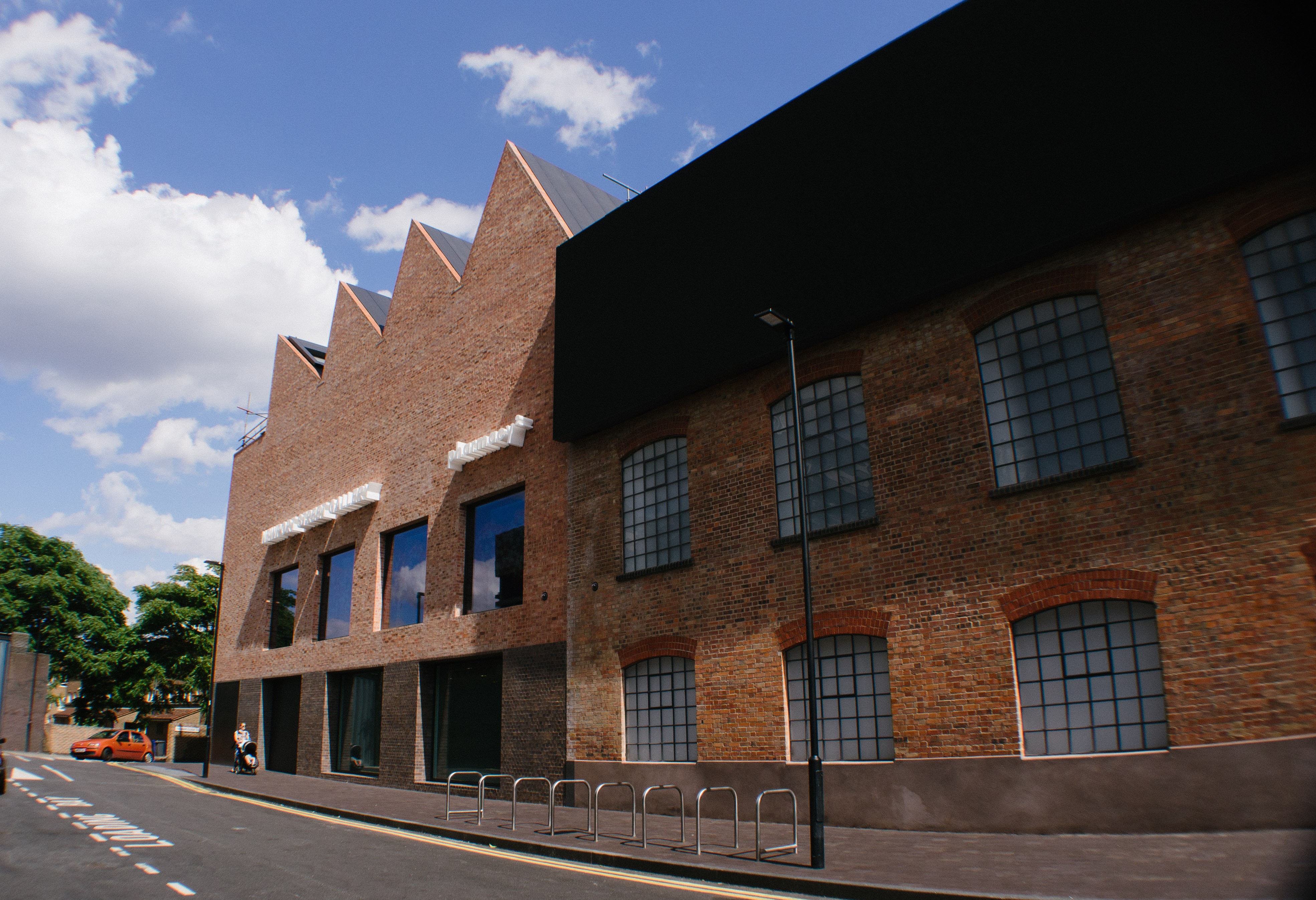
And in early 2026 he is hanging in serious company. "Triple Trouble," running 10 October 2025 to 29 March 2026 at Damien Hirst's Newport Street Gallery in London, puts Invader alongside Shepard Fairey and Hirst himself. Three artists, three repeated marks: Fairey's OBEY face, Hirst's spots, Invader's alien. The show is built on exactly the thing this article is about: repetition turning a symbol into a language. Entry is free, which fits a man whose main gallery is the street.
Why a repeatable mark becomes a brand
Strip away the space station and the diving gear and Invader did one thing well. He chose a single, simple, repeatable image and put it out so many times, so consistently, that people learned to read it. Then he gave them a reason to keep looking: a map, a count, a game. The shape carried the meaning. He never had to explain it.
That is the lesson for anyone working with a repeated mark, and it is exactly how a good stencil works. Cut one design once and you can spray it a hundred times, identical every time. The repetition is what makes it stick in a head. A logo, a tag, a stencil, an 8-bit alien: same rule. Pick a shape that survives being copied, then copy it until it is yours. We build stencils for that job. One cut, sprayed clean and identical as many times as you want, until the mark stops being a picture and starts being a name.
Sources
- Invader (artist) - Wikipedia
- Space2 on Columbus - ESA
- There's an Invader in the International Space Station - Smithsonian Magazine
- Hong Kong Phooey replica fetches HK$2 million at auction - South China Morning Post
- HK$2 Million for Invader's Replica of Hong Kong Phooey Work - Artnet News
- Triple Trouble: Fairey, Hirst, Invader - HENI Exhibitions
- A Full Guide to Invader's App FlashInvaders - Illuminate
- Invader's Underwater Mosaics in Cancun Bay - Illuminate
Related reading from TasteBueno
- Stencil graffiti before Banksy: the artists who built it
- MURAL Festival Montreal 2026: the street-art week that takes over Saint-Laurent
- A Belgian Beach Town Built the Best Street Art Collection in Europe. It Took Ten Years and a Napoleonic Fort.
- Sotheby's is finally auctioning the graffiti writers who started it all

0 comments