

Walk past a stenciled figure on a wall in 2026 and most people land on one name. Banksy. The crisp black silhouette, the political jab, the image that showed up overnight with nobody around to take credit. People assume he invented the form. He did not, and he has said so in plain words. The man he was quoting had been cutting and spraying stencils on the streets of Paris two decades before Banksy ever held a can. So who actually built this thing, and how far back does it really go?
Further than you think. This is the lineage Banksy stands on, and these are the people who put the bricks down.
The father: Blek le Rat, Paris, 1981

Start with the man Banksy himself credits. Xavier Prou, working as Blek le Rat, started stenciling on the streets of Paris in 1981. He is the one most historians point to as the father of stencil graffiti, and the title is earned, not handed out. The name comes from a comic, Blek le Roc, with "rat" swapped in because rat is an anagram of art. Those rats were his first signature, small black rodents sprayed low on Paris walls, multiplying across the city.
Here is the part that gets buried. Blek did not start with art-school theory. He got the idea young. He has talked about seeing old stenciled propaganda images of Mussolini on walls in Italy, and the directness of it stuck with him for years before he acted on it. When he finally did, he moved past rats to life-size human figures, full bodies cut from cardboard and sprayed in one pass so they read like a person frozen against the brick.
And the Banksy connection is not a fan theory. Banksy put it on the record himself: every time he thinks he has painted something original, he says, he finds out Blek le Rat did it as well, only twenty years earlier. That is the whole argument for this article in one sentence, from the only witness whose opinion the doubters will accept. But Blek was not first either. To find the start you have to go back another fifteen years, and out of the spray-paint world entirely.
Back further: Ernest Pignon-Ernest, 1966

Ernest Pignon-Ernest, born in Nice in 1942, is the name people reach for when they want to push the clock back past the 1980s. He is widely called a forerunner of street art in France, and his first public intervention dates to 1966, on the Plateau d'Albion, where the French were installing nuclear missiles. He put images into public space as a direct response to that, the silhouette of a body burned into the ground in the manner of the Hiroshima shadows.
His main tool was screenprinting rather than the cut stencil, life-size figures printed and pasted onto walls, steps and doorways. So why does he belong in a stencil history? Because he proved the core idea before anyone else in France made it a movement: put a strong printed image directly onto the street, unsanctioned, tied to a political point, and let the location do half the work. The stencilists of the 1980s were working in a door he had already kicked open. He also was not inventing the political street image from nothing. He was drawing on a tradition older than all of them.
The tradition underneath: protest stencils

The stencil was a political tool long before it was an art-world one. The form is built for it. A stencil is repeatable, fast, and anonymous, three things a protest movement needs when it wants a message on a wall and wants to be gone before the police arrive.
Paris in May 1968 is the obvious touchstone. The Atelier Populaire, run out of the occupied École des Beaux-Arts, pumped out hundreds of screenprinted and stenciled protest posters during the uprising, slogans and raised fists produced fast and cheap for the walls of the city. The same logic ran through Latin American protest for decades. Stencils, esténcil, became a standard tool of political street expression across Argentina and beyond, the cheapest way to repeat a demand or a name down a whole street. None of these people were thinking about gallery prices. They were thinking about getting a message up before sunrise. That instinct is the spine of everything in this article, and it was alive in New York at the same time, in a very different accent.
New York: John Fekner, late 1970s
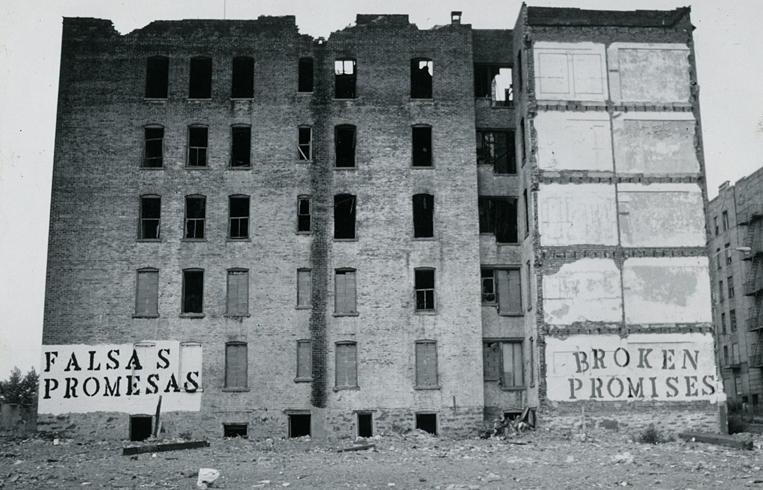
While the French scene was forming, John Fekner was working the South Bronx and Queens. Born in 1950, Fekner started spraying stenciled words onto the city's broken buildings in the mid-to-late 1970s, and he did hundreds of them. Not pictures. Words. "Broken Promises." "Decay." "Wheels Over Indian Trails," sprayed on a highway overpass.
Fekner used the stencil as a flat statement bolted onto the exact spot it described. A stenciled "DECAY" on a crumbling wall in a borough the city had written off was the argument and the evidence in the same frame. He is one of the clearest cases for stencil and text street art predating the European boom, and he was doing it an ocean away from Blek with no contact between them. That is the tell. The form was surfacing in more than one place at once, which is usually how you know an idea's time has come. Paris just happened to grow the deepest bench.
The Paris bench: Jef Aerosol and Jérôme Mesnager

Blek did not work alone for long. Jef Aerosol, real name Jean-François Perroy, born 1957, started cutting stencils in 1982, right behind Blek. His thing was the life-size black-and-white portrait, often of musicians and ordinary people, finished with a small red arrow that became his tag. He is still at it, and the red arrow still shows up.
Then there is Jérôme Mesnager, born 1961, who in 1983 created the figure he is still known for, l'homme blanc, a white body painted straight onto Paris walls. Mesnager worked more with the brush than the cut stencil, but he belongs in the same room and the same years, part of the Paris street scene that turned a handful of individual habits into a recognizable movement. By the mid-1980s the city had a working vocabulary for putting figures on walls. That vocabulary is exactly what a kid in Bristol would pick up and run with a decade later.
Where Banksy fits
None of this is meant to knock Banksy down. He took the form, sharpened the joke, and got it in front of more eyes than any of the people above ever reached. That matters. But "made it famous" and "invented it" are not the same claim, and the second one falls apart the second you look. The rat was Blek's. The life-size sprayed figure was Blek's. The political image on an unsanctioned wall runs back through Pignon-Ernest to 1968 and back through Fekner in New York and back through every protest movement that ever cut a slogan into cardboard.
That is the honest version of the story, and it is a better one. Banksy is not the start of a line. He is one bright point on a line that runs back sixty years, drawn by people who mostly did it for nothing and got paid in arrests. When you cut your own stencil, you are joining that line, not copying a brand.
That is also the whole reason we cut the stencils collection the way we do, real subjects with a point of view, made to spray, not to frame. And if you want to see what these names actually put on the street, the references and the work that built the form, we keep pulling it together over on the wall. There is a Latin American chapter of this story we have barely opened here, and that one is coming next.
0 comments