

There is a reason the people in charge send crews to scrub walls instead of sending critics to review them. A painting hangs in one room and waits for you to come find it. A stencil finds you, on your walk to work, a hundred times in a week, until the thing it is saying stops feeling like an opinion and starts feeling like the weather. That is not an accident of taste. It is a property of the tool, and it is the reason the stencil has been the weapon of choice for every broke, angry, outnumbered person who needed a wall to argue back.
I want to make a flat claim and then back it. Of every method on the street, the stencil is the one built for politics. Not the best looking. The sharpest. Here is why, and here is the history that proves it was never about decoration.
Speed is the whole argument

Freehand a portrait on a wall and you are standing there for an hour, exposed, explaining yourself to anyone who walks by. A stencil collapses that hour into about four seconds. Line it up, spray it, peel it back to a clean edge and overspray, and you are already walking away before anyone clocked what you were doing.
That speed is not a convenience. It is the difference between getting the message up and getting caught. Political street art happens in places where getting caught means a beating, a cell, or worse, and the stencil exists because someone needed to say a dangerous thing fast and leave. Hold that thought, because the people who needed it most were not artists at all.
One cut, a hundred identical hits

Cut a stencil once and you can spray it a hundred times before the edges soften. Same face, same fist, same slogan, on the underpass, the bank shutter, the cop station wall, the bus stop. A freehand piece is one statement in one spot. A stencil is the same statement repeated until it reads as consensus.
This is the part that turns an image into a movement. Repetition is how a private thought becomes a public fact. When you see one stencil you think someone is angry. When you see the same stencil forty times across a city you think everyone is. The wall starts doing the organizing for you.
Buenos Aires is the clearest proof. After Argentina's economy collapsed in 2001, the streets filled with stencil art, esténcil, aimed straight at the banks, the police, and the politicians who had emptied people's accounts overnight. Crews like BsAs Stencil put the same biting images up across the city, and the repetition was the message: this rage is not one person, it is the whole town. Argentina already had the muscle memory for it. During the last dictatorship, the mass street action known as El Siluetazo filled public space with life-size human silhouettes, one cut shape stood in for one disappeared person, multiplied by the thousands. The form was the politics. Many made one.
No signature, no brushstroke, nothing to trace
A freehand artist leaves a hand. Style, line weight, the way they build a letter, all of it is a fingerprint that gets you identified and prosecuted. A stencil leaves none of that. The cut does the drawing, so every spray looks identical and machine-flat. There is no personal mark to match you to the wall.
For protest art under a regime, anonymity is not a pose, it is survival. The cleanest example is the White Rose, the student resistance group in Munich who handed out leaflets against Hitler. In their final stretch they took the fight to the walls, using a stencil to paint slogans like "Down with Hitler" and "Freedom" across the city. A stencil let a handful of students speak in a voice that sounded like a crowd, with nothing on the wall to point back at them. The core members were caught through other means and executed. The walls never gave them up.
It costs almost nothing
A sheet of mylar, a blade, a can. That is the entire budget. You do not need a gallery, a grant, a printer, or permission. Movements that have money do not need the street, they buy billboards. The street is where the people without money go to be heard, and the stencil is the cheapest loud thing you can make. The barrier to putting a political image in front of a whole city is about the price of lunch.
That economics is why the form keeps showing up wherever power is lopsided. The side with everything gets ad agencies. The side with nothing gets a cut sheet and a wall, and somehow the cut sheet keeps winning the argument.
One high-contrast image, read from across the street

The stencil forces a decision most art avoids. Black or open, in or out, no middle. You cannot do soft shading or fine gradients, so you are pushed to one bold high-contrast image that reads instantly. A passing driver gets it at forty feet and forty miles an hour. It lands before the brain has time to argue, and it sticks.
That graphic punch is exactly what propaganda has always wanted and rarely earned, and the street version does it with none of the budget. Which brings us to the two names everyone reaches for.
Blek le Rat, Banksy, and the case closed
Blek le Rat, real name Xavier Prou, started spraying stencils on the walls of Paris in the early 1980s and is widely called the father of stencil graffiti. His signature was a small rat, the one animal he said could bring down a city, and his work carried social weight from the start, putting the homeless and the outsider on walls that pretended they did not exist. He chose the stencil on purpose. Fast, repeatable, his.
Banksy took the same tool and aimed it at everything: the police, the surveillance state, the war machine, the art market that eventually tried to swallow him. Banksy has openly credited Blek's influence, with the often quoted line that every time he thinks he has painted something original, he finds Blek le Rat did it twenty years earlier. The point is not who was first. The point is that the most recognizable political street artist alive built his whole voice on a cut piece of card, because the cut piece of card was the only tool that could be that fast, that repeatable, that anonymous, and that loud at the same time.
That is the case. Every other method does one or two of those things. The stencil does all five at once, which is why it keeps ending up in the hands of whoever the wall belongs to that week.
If the wall is yours, pick your subject
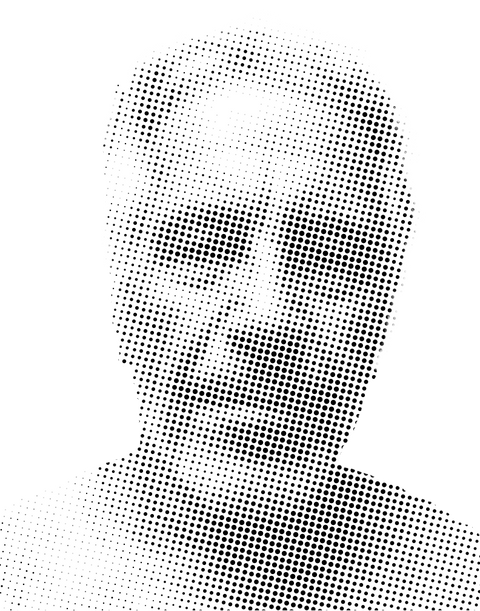
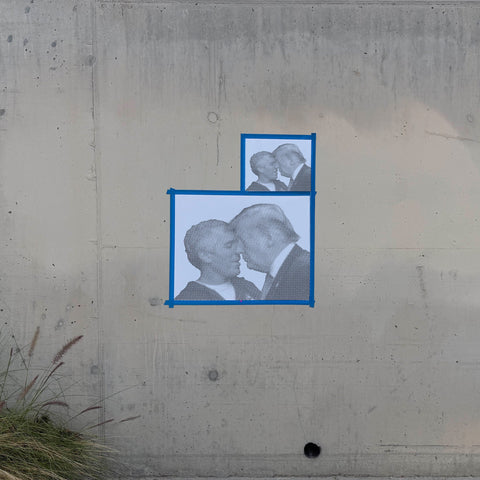
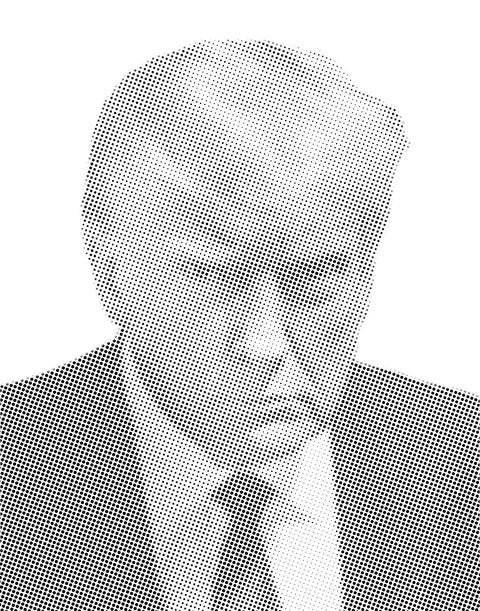
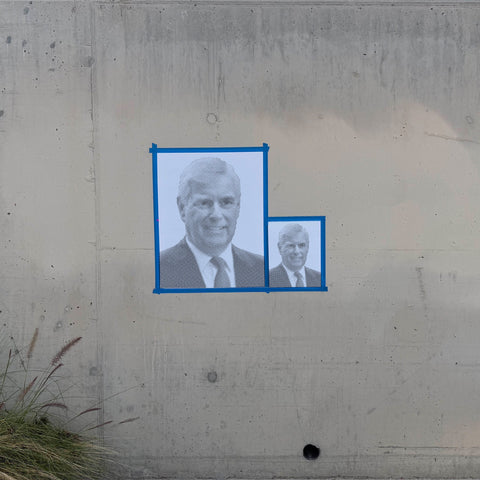
None of this stays in a museum. It is a working tool, and it still works. We cut in that tradition on purpose, which is why the political subjects in the stencils collection are not softened for the gift shop. If you want a target with some history behind it, the Donald Trump stencil reads from across the street the way the form is built to, and the Trump and Epstein kissing stencil is the kind of image that does the arguing for you, no caption required.
Pick your subject, cut it once, and let the wall repeat it. The next piece in this series gets into the part nobody tells you: how to spray a political stencil so the edge stays sharp enough to actually land, even when you only get one fast pass before you walk.
0 comments