

Ronald Reagan stood in the rubble of the South Bronx on August 5, 1980, and told reporters he hadn't seen anything like it since London after the Blitz. The wall behind him was spray-painted with one word, in stencil letters six feet tall: Decay.

A photograph of a burned neighborhood, and a word painted on it
Charlotte Street had become the visual shorthand for urban collapse. Jimmy Carter walked the same rubble in 1977, and the photographs from his visit became one of the defining images of that decade of American decline, according to Gothamist. By the time Reagan arrived three years later to score points off Carter's unmet promises, the block had a new addition: hand-cut stencil lettering, sprayed directly onto the wrecked buildings by an artist named John Fekner.
Cardboard, not a laser
Fekner had been stenciling New York since 1976, tagging the industrial stretches of Queens, the East River bridges and the South Bronx using hand-cut cardboard stencils and a can of spray paint, per Wikipedia. His words were blunt on purpose: Industrial Fossil. Urban Decay. Decay/Abandoned. No tag, no character, no stylized signature loop. Just a word, stenciled onto the exact building it described.
In the last week of July and first week of August 1980, Fekner cut a new batch of stencils for a specific job. Local activists were staging the People's Convention, an outdoor counter-event timed to the Democratic National Convention, where delegates a few miles south in Manhattan were re-nominating Carter. Fekner stenciled Broken Promises, Falsas Promesas, Decay, Broken Treaties, Last Hope and Save Our School across the Charlotte Street ruins, according to Gallery 98.
A campaign stop in front of someone else's message
Nobody arranged for Reagan to stand in front of a Fekner stencil. He was there to campaign, not to pose next to street art. But the photographs from that day put his promise to rebuild directly behind Fekner's one-word verdict on the neighborhood, an accidental collision between a presidential campaign and an artist who had already been stenciling that same message onto Bronx walls for years before either candidate showed up.
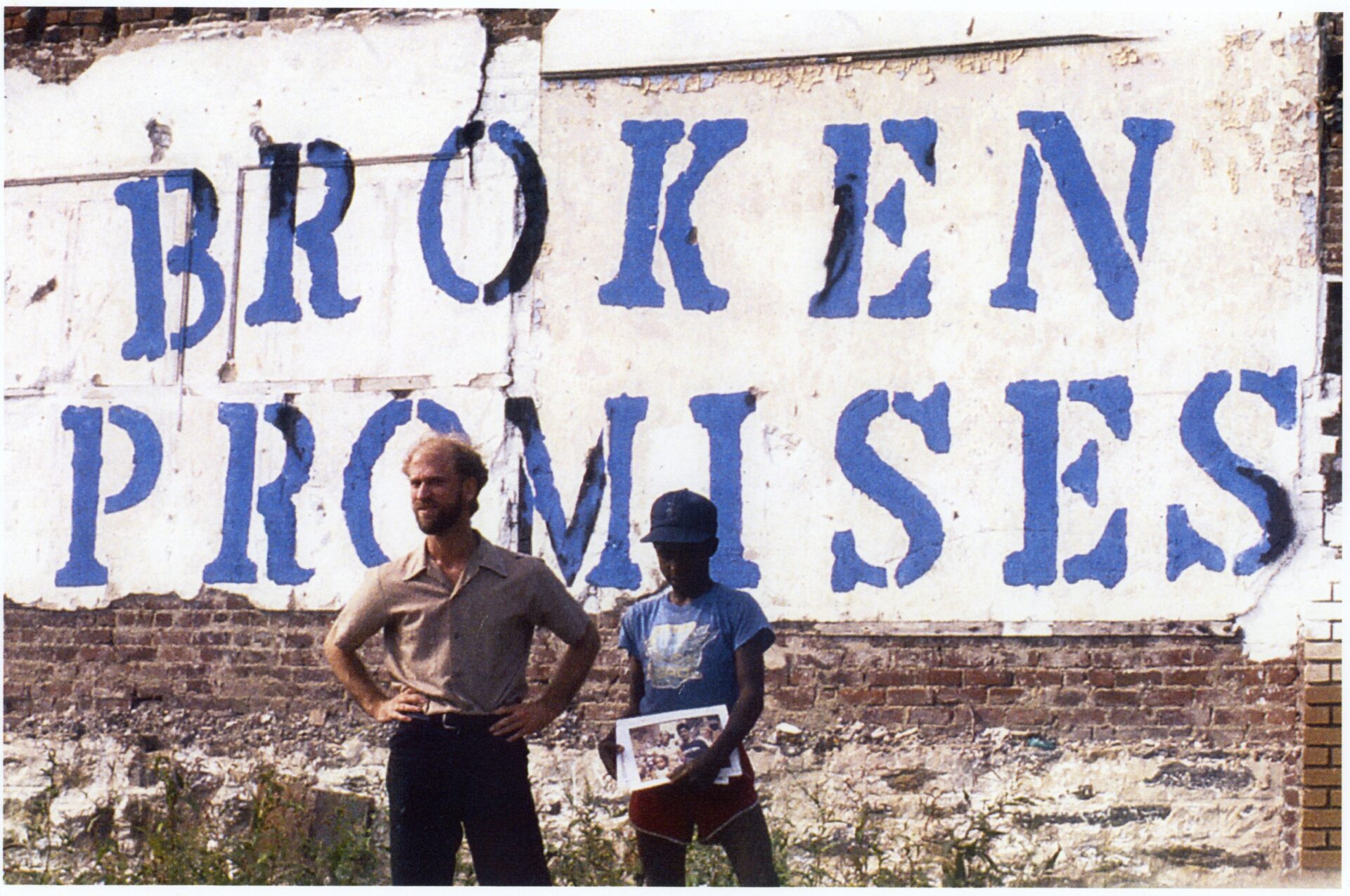
Fekner didn't chase the attention. Not long after the Charlotte Street stencils ran in newspapers alongside coverage of Reagan's visit, he moved away from street stencils and toward multimedia work. He'd already made his point across more than 300 site-specific pieces stretching from Queens overpasses to Bronx tenements, tackling industrial pollution and housing neglect, and in pieces like Wheels Over Indian Trails, the treatment of Native American communities.
The stencil outlived the wall
Charlotte Street doesn't look anything like it did in 1980. Prefab ranch houses went up on the block in 1985, and the transformation was total enough that a Bronx borough historian later couldn't pin down exactly where Carter had once stood, per Gothamist. The rubble is gone. The stencils sprayed onto it are not, because somebody photographed them before the walls came down, and those photographs are the reason Fekner's cardboard cutouts get cited today as some of the first stencil work built entirely around political urgency rather than a tag or a character.
That's the throughline from a hand-cut cardboard stencil in the South Bronx in 1980 to the Stencil Library today: cut a shape, hold it against a surface, spray. The tools got sharper. The idea that a stencil can say something specific about the exact wall it's on hasn't changed at all.



0 comments