

For eleven years, every driver crossing into Queens from the Pulaski Bridge passed the same six stenciled words on a retaining wall, and then one day in 1990 they were gone, not because the city painted over them, not because a rival writer buffed them, but because the man who put them there decided the sign had said enough and rolled a coat of paint over his own work.
A kid with cardboard and spray paint
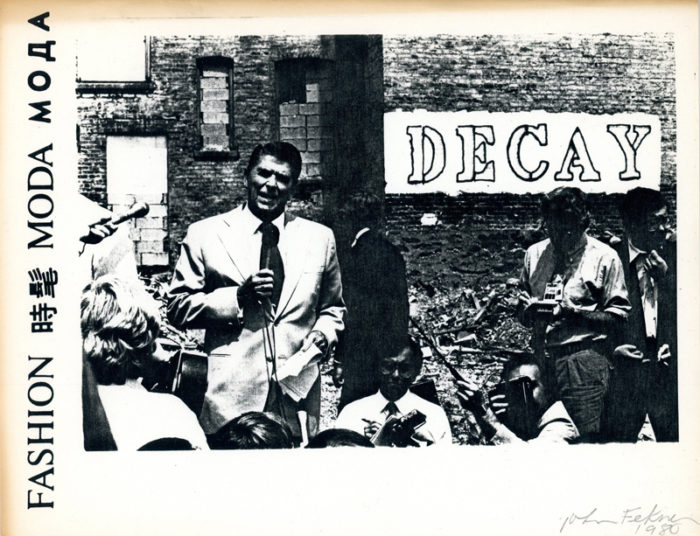
John Fekner, born in 1950, started tagging as a teenager, first with freehand words like Itchycoo Park sprayed at a Jackson Heights park in 1968. By 1976 he'd switched methods, cutting his own stencils out of cardboard and spraying short, blunt phrases onto abandoned buildings, overpasses, and retaining walls around New York City, according to his biography. He wasn't tagging a name. He was stenciling accusations. Words like Decay, Broken Promises, and Toxic Junkie showed up on buildings the city had functionally abandoned, turning derelict walls into something closer to protest signage than graffiti. Over roughly a decade and a half he put up more than 300 of these pieces across the boroughs, most of them gone within days or weeks, torn down by weather, buffed by property owners, or simply forgotten.
Wheels over Indian trails
The one that lasted was different. In 1979, Fekner stenciled the phrase Wheels Over Indian Trails onto a wall near the Pulaski Bridge, the crossing that carries traffic between Brooklyn and Queens over Newtown Creek and feeds toward the Queens-Midtown Tunnel. He later said the piece was meant to capture the feeling that America had paved over Native peoples, their land, and their history, layering a car-culture landmark on top of ground that carried an older, erased story. Unlike almost everything else he made, nobody removed it. The stencil sat on that wall greeting commuters and travelers arriving in New York for eleven straight years, a run practically unheard of for unsanctioned street text in a city that buffs graffiti fast, according to research collected in Fekner's own archive.

He killed it himself
Fekner ended it on Earth Day 1990, painting over his own eleven-year-old stencil because, by his own account, he felt the piece had run its course. That's the part of the story that doesn't fit the usual street art arc. Most stencil work dies by outside force: a buff truck, a new tenant, a city contractor with a paint roller and no idea what they're covering. Fekner's biggest hit died because its author decided it was finished saying what it needed to say and erased it on purpose, on a symbolic date, with nobody forcing his hand. It's closer to an artist pulling a book out of print than a mural getting demolished.
The Bronx piece that made the point louder
Fekner's sharpest work came a year earlier, in the South Bronx, where he and collaborator Don Leicht stenciled Broken Promises and its Spanish twin Falsas Promesas across a devastated lot on Charlotte Street, the same block President Carter had walked through in 1977 as a symbol of urban collapse. The stencil turned a photo-op backdrop into a direct rebuttal: politicians visit, promises get made, buildings stay in ruins. That's the throughline across all of Fekner's stencil work. He wasn't decorating decay, he was captioning it, using the same hand-cut, reusable, disposable format that any stencil artist works in today, just aimed at municipal failure instead of a portrait or a logo.

Why it still matters to anyone with a blade and a sheet of mylar
Stencils survive because they're fast, repeatable, and anonymous, which is exactly why Fekner picked cardboard and a spray can over a paintbrush in the first place. The tools have changed. A laser can cut a sheet of mylar cleaner and faster than any hand with an X-Acto knife ever could, and if you want production-ready halftone stencils instead of hand-cutting your own from scratch, the Stencil Library has hundreds of cut-ready files for exactly that. But the logic hasn't moved an inch since 1976: cut a shape once, spray it as many times and in as many places as the message needs, and let the wall do the talking. Fekner proved a stencil could carry an argument for eleven years on a bridge nobody controlled. Most of us are just trying to get a clean edge on a t-shirt.


0 comments